Goldilocks Guide-Shower Filters

DETAILS
When — 2024-2026
What — Showerhead Filters
Brand — Various
Rating — Meet
Shower Filter Goldilocks Guide
Not every product comparison fits neatly into MISS / MEET / EXCEED.
Sometimes several products are perfectly good. They do what they claim. They may even deserve a MEET across the board. The real issue is whether they are a good fit for your lifestyle.
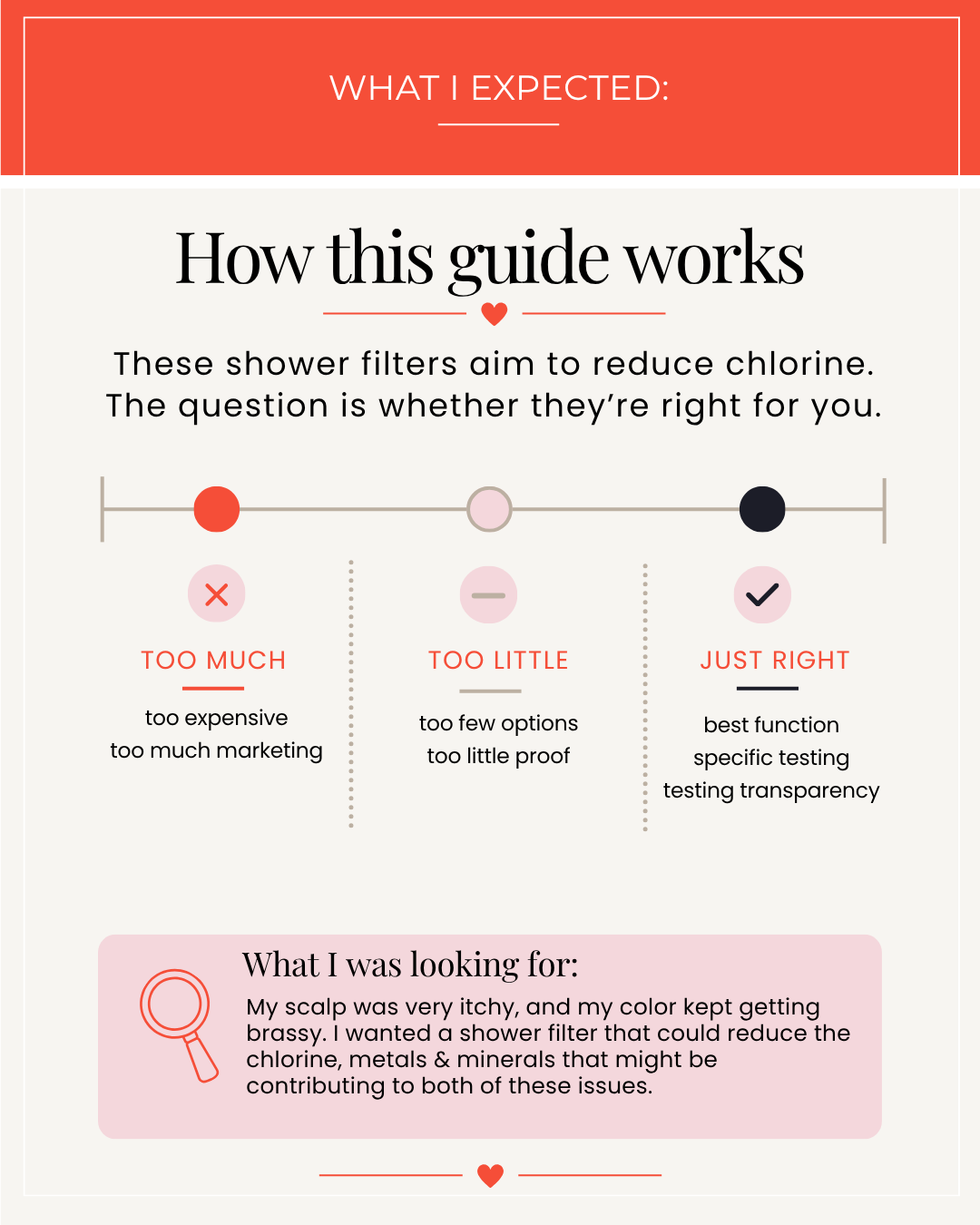
That is where The Goldilocks Guide comes in: my roundup format for products that do what they promise but still vary in ways that matter in real life.
For this guide, I tested a group of shower filters through the lens of hair, scalp, and skin comfort, not drinking-water safety. That distinction matters.
Municipal water systems have an important job: keeping water safe for drinking. Chlorine and chloramines exist for a reason; I’m not questioning their purpose. I’m simply trying to reduce what hits my skin and hair in the shower. Here are the key considerations when considering a shower filter:
water-quality reports for the area specifically
whether or not you are on well or public water
publicly available filter third-party consumer & water-quality testing
disclosure of testing protocol, parameters
filter type, design options, use with existing head
water pressure options (heavy filtration can impact water pressure)
metal or plastic parts (personal preference)
reduction of specific contaminants that could be contributing to your issues (in my case, those issues were brassy hair & itchy scalp)
The Big Takeaway
If your skin, scalp, and hair color are fine, you may not need a shower filter. You may still want one, and okay, you do you. If you are dealing with an itchy scalp, shedding, skin issues, color oxidation, dry-feeling hair, or mineral-heavy water, then a shower filter could help.
I am including links below about water quality so you can do your own homework. Or you can call my husband, who happens to be a water-quality expert and would love to discuss water for hours. Honestly, it would keep him occupied, so you would be doing me a favor.
If you are on well water, you should get your water tested periodically, not only to ensure it is safe to drink, but also to know what is in it. My husband laughed me out of the room when I broke out my Amazon-purchased water-quality test strips. Apparently, consumer test strips are NOT the same as formal water testing in a laboratory.
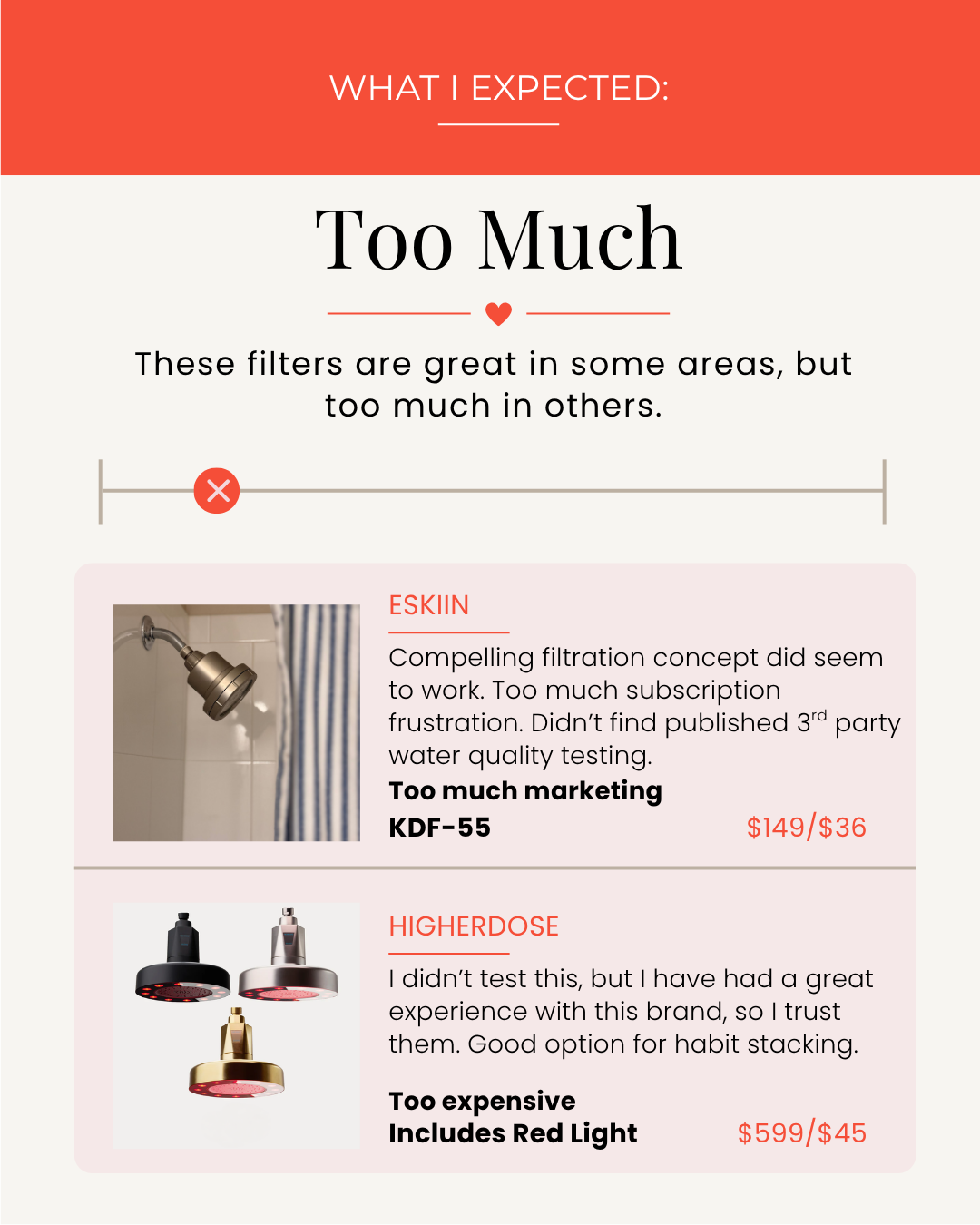
This category is more complicated than it looks. Some filters focus mainly on chlorine. Some make broader claims about metals & other contaminants. Some include KDF-55 filtration, which claims to reduce chlorine & water-soluble heavy metals in hot-water applications. Some work with existing showerheads, others are functionally limited. And some brands make it easy to buy, but very annoying to stop receiving filters. (Looking at you, Eskiin).
A lot of shower-filter marketing talks about hard water. This is where the conversation gets messy.
Hard water usually refers to water with high levels of minerals like calcium and magnesium. A shower filter may improve the feel of your water and reduce chlorine, some metals, and other contaminants, but that does not mean it will truly soften hard water. If you have true hard-water issues, like scale building up everywhere, a shower filter will not solve the whole problem.
If you have true hard-water issues, scale building up everywhere, a shower filter won’t solve it. This guide focuses on shower water and its effects on hair, scalp, skin comfort, and color-treated hair.
What I Expected
I made a mistake, which is sadly how many of my stories begin. I bought a filter after an influencer recommended it. I liked the look of it, but later realized it didn’t use the filtration approach I needed for my specific water-quality issues.
That was the lesson. You can’t choose a shower filter based on aesthetics alone. You have to start with your specific water.
Many filter companies cite third-party testing. This also got a laugh out of my husband.
As it turns out, “third-party tested” can mean several different things.
There is third-party testing which considers the marketing or beauty-perception claims, i.e., “my skin felt better.” There is third-party water-quality testing for things like chlorine reduction or drinking-water safety. And finally, there is contaminant-specific testing for the presence and/or levels of specific minerals, metals, and other contaminants. These all fall under the claim “third-party testing,” but are clearly not the same thing.
If your head isn’t already spinning, there is one more consideration on testing: protocol.
A test with cold water may yield different results than one with hot water. This is a shower; you are likely using hot water, so hopefully the filter company is testing appropriately. I also want to know how the filter performs on day one versus near end of its filter life.
I assume efficacy decreases over time, which is why most brands recommend replacing the filter every 90 days. Real testing transparency should disclose performance over time.
I do not own a lab, nor did I pay for expensive lab testing. I bought these filters and used them. I am a normal consumer and, as such, reviewed everything publicly available.
What Happened
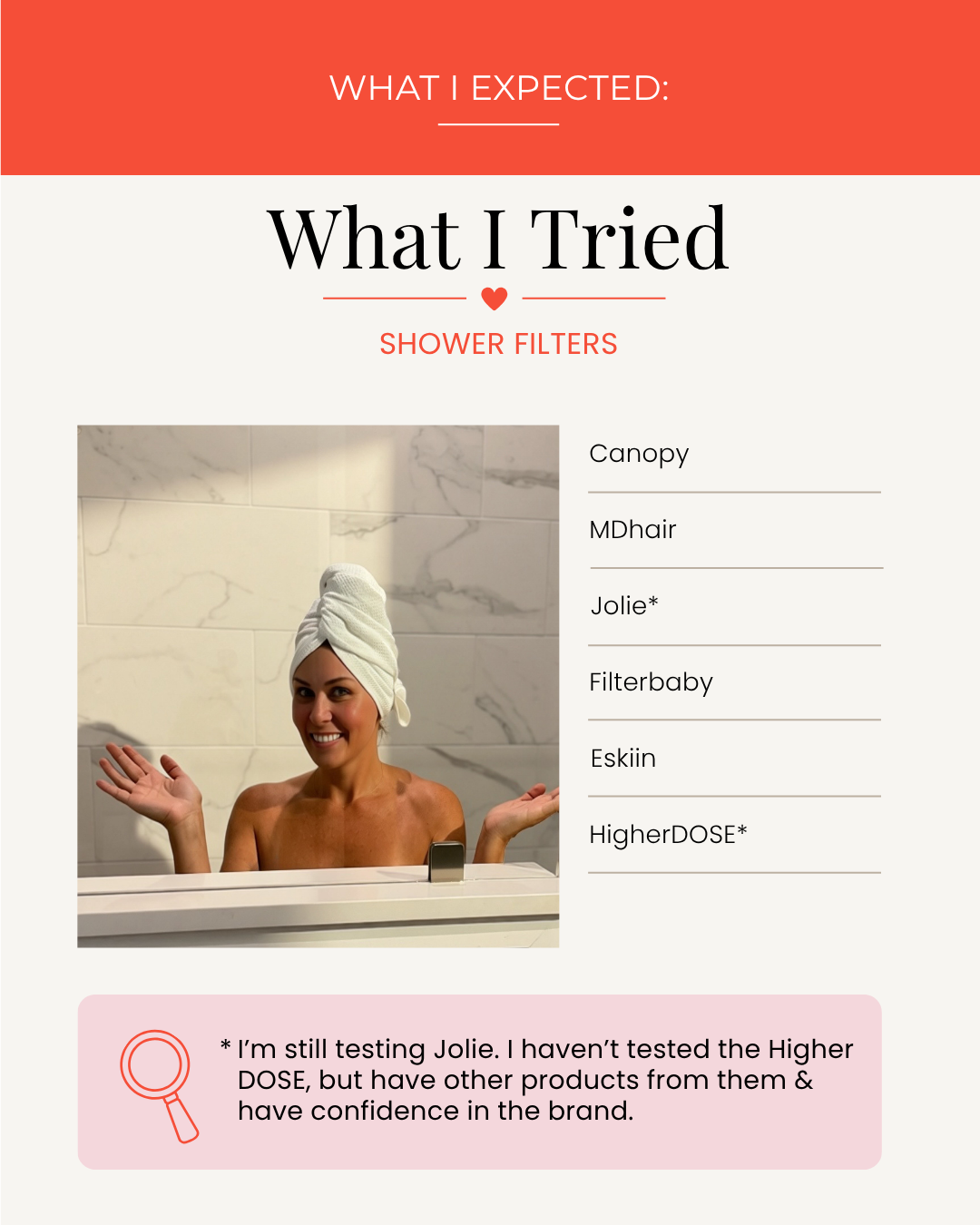
All of these filters are a MEET in the sense that they aim to reduce chlorine, but only a few were just right for what I wanted. For me, that was Canopy in one bathroom, Filterbaby in the other.
The short list, in plain English
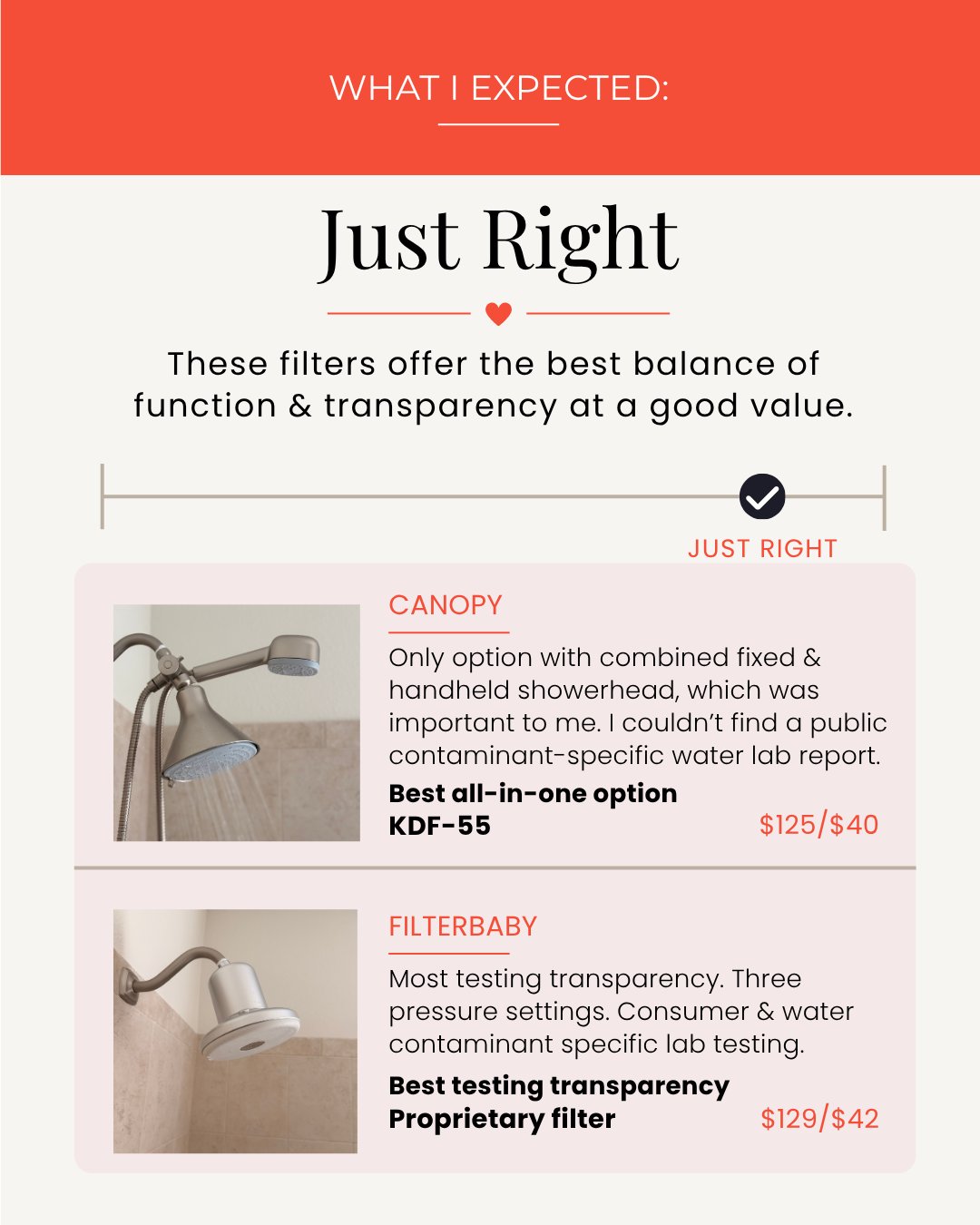
Best if you need a fixed & handheld shower head combo: Canopy
Best testing transparency: Filterbaby
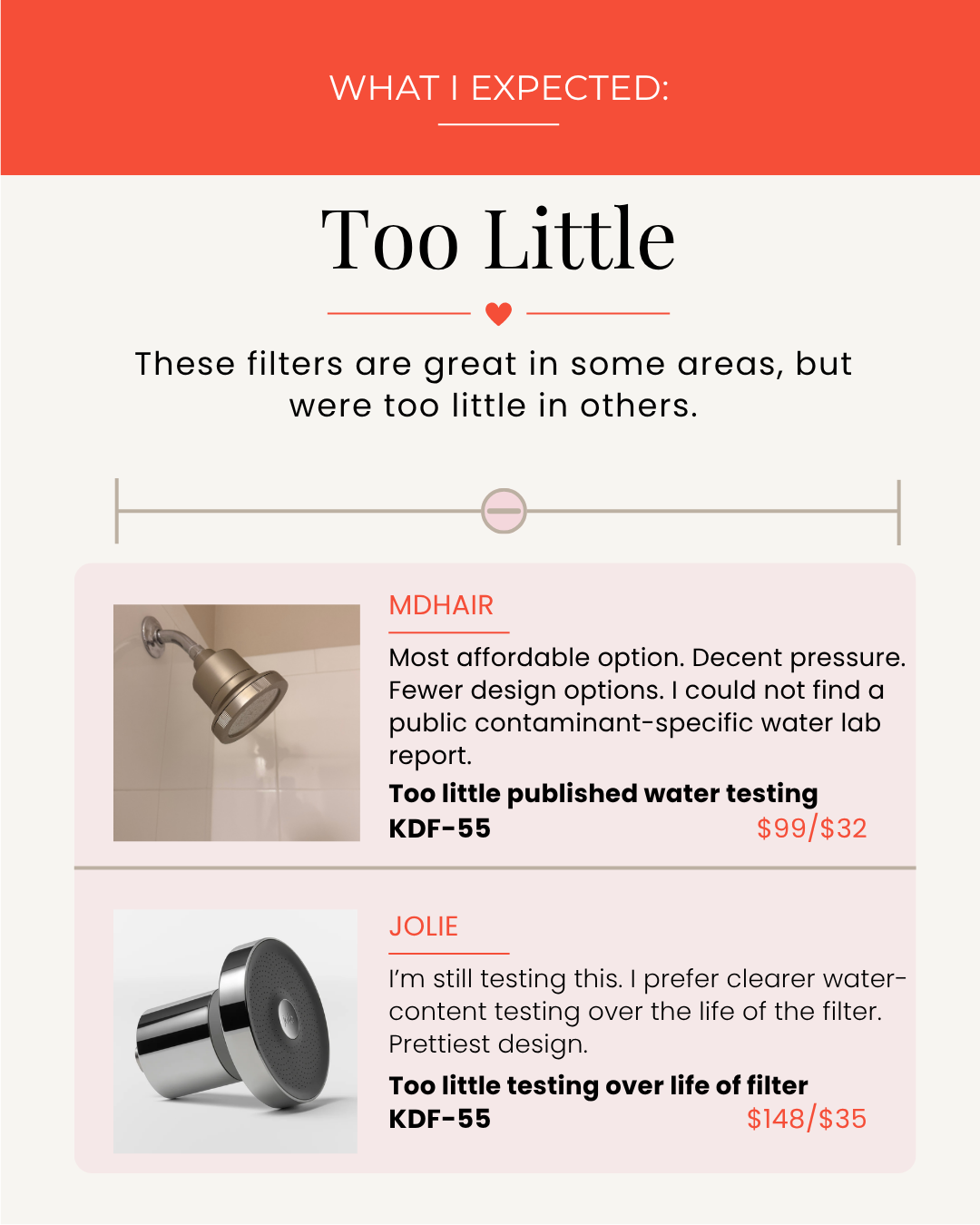
Best for design-focused option: Jolie
Best for tight budgets: MDhair
Best for forcing you to replace your filter: Eskiin
Best for stacking wellness habits: HigherDOSE
Click here for a one-page chart to help you decide which is best for you.
Not sponsored. Not gifted. Not compensated. Just my shower and my opinion.
This post may contain affiliate links. If you buy through these links, I may earn a commission at no extra cost to you.